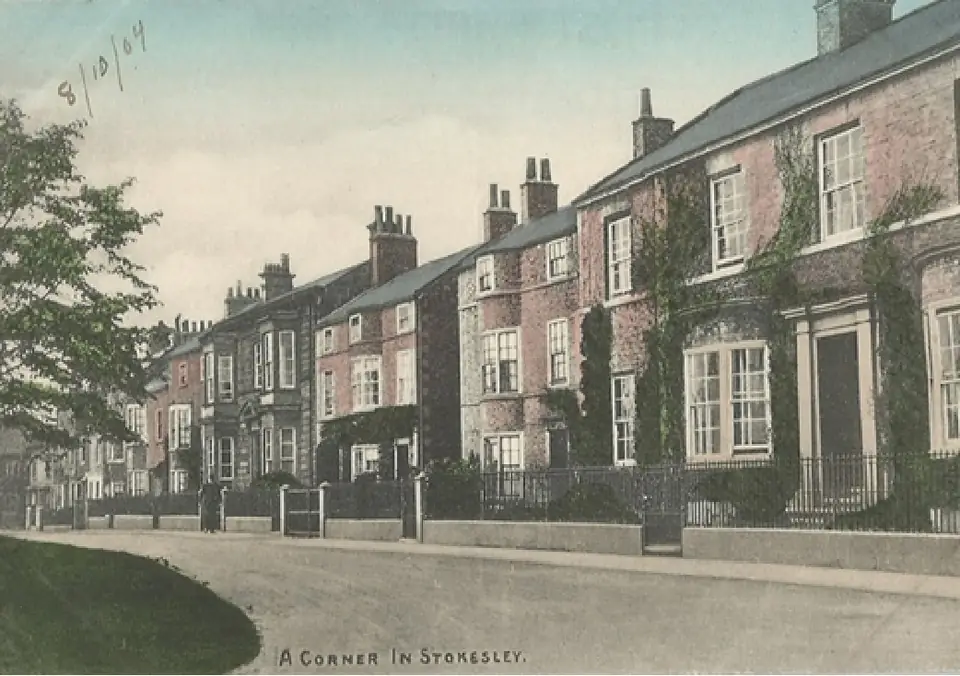
Picture the Trinity Fair in Stokesley in 1808: the cattle in the street, the stalls, the noise. And into the middle of it, by one account, walks a man of about forty-five in a red coat and white waistcoat, black breeches and white stockings, a drab hat on his head, long brown hair hanging over a face painted bright vermilion. Every so often he pushes the hair back down over his eyes with both hands. He looks, the writer says, more like a madman than a wise one. From that day, the same writer tells us, the town had a Wise Man.
That account was printed in 1842, in a popular collection called Wonderful Characters, some thirty years after the fair it describes. It is the earliest source for most of what we think we know about John Wrightson, and it is worth keeping that in mind. The local historian Alice Barrigan, who has gathered every surviving account of him, is admirably frank about how little of it can be pinned down.
What can be proved
Not very much, but enough to be sure he existed. In 1819 a Yorkshire gentleman wrote to the antiquary Sir Henry Ellis describing “impostors” called wise men who still worked in the county, and named one: John Wrightson, lately living at Stokesley, who called himself the seventh son of a seventh son and professed the trade of cow-doctor. People came to him, the writer complained, to find thieves, to cure themselves and their cattle, to learn their fortunes, and to avoid being balloted into the militia. This was the time of the Napoleonic wars, and the last of those requests says a great deal about what ordinary people were afraid of.
There is a printed business card, too, said to have been made for him in Whitby in 1808, offering relief from “inward disorder” and shortness of breath to anyone who would send him a sample of their water, “likewise cattle that do not thrive”. A card of this kind is in the Pitt Rivers Museum in Oxford. And in July 1815, a John Wrightson of New Malton, cow doctor, entered into a recognizance to appear at the Quarter Sessions in Northallerton. Whether that was our man, nobody yet knows.
He had only to name someone as a witch, the 1819 writer said, and she would be shunned for the rest of her life.
What was said
Everything else is story, and there is a great deal of it. Wrightson’s cottage was thatched and stood at the west end of the town, where he also, rather disarmingly, sold gingerbread. He kept a dark room where he consulted an old black-letter book. He knew, before a word was spoken, why his visitors had come. Two drovers who tried to trick him by saying a horse was missing, when it was really two cows, were told off before they were through the door, and then told the cows were in the beck, where they were found. Two young men who called on him for sport found themselves pinned to their chairs in front of a fire that grew hotter and hotter until he let them go.
These tales come to us through the Victorian folklorists: Canon Atkinson of Danby, who heard them from old men who had met Wrightson in their youth, and Richard Blakeborough, who believed in the Wise Man’s powers entirely. Atkinson took a cooler view. He thought Wrightson a man of rough humour and real skill with herbs, but also a performer with a very good intelligence service: a housekeeper and an odd-job man at home, and, it was said, an ostler at one of the Stokesley inns who passed on everything he overheard from the visitors stabling their horses.
The sceptics
Stokesley itself was less impressed. George Markham Tweddell, the radical printer born in the town in 1823, thought Wrightson “little better than a huge swindler”. And in November 1850, at the dinner to open the town’s Mechanics’ Institute, the printer Henry Heavisides, who had worked in Stokesley as a young man, stood up and told the company he had known the Wise Man well: a “sad tyke”, he said, and as arrant an impostor as ever fattened on other people’s credulity. The days of fortune-telling, Heavisides was glad to say, had passed away.
There was a darker side, too, which the gentler storytellers left out. The 1819 correspondent claimed that Wrightson’s cures sometimes required acts of cruelty to animals, and that he had only to name a woman as a witch for her neighbours to turn on her for good. Barrigan connects him, cautiously, with the death of a farmer near Bedale in 1799, poisoned by a thief who claimed to be passing on pills from a wise man.
How did it end?
Here the record gives up altogether. The 1842 account says he was found dead in a post-chaise on the way to the House of Correction at Northallerton, where he had been committed for assault. A later writer had him falling backwards out of the cart. Another had him fleeing to Malton, and taking poison as the carriage passed through Hovingham. Local histories give the year as 1818. No burial has been found.
It is, perhaps, the right ending for him. A man who made his living from what people could not quite explain has left behind a life that nobody can quite account for. Whether he had powers is a question each reader will answer for themselves. What is certain is that, for a few years in the early nineteenth century, half of Cleveland came to a cottage at the west end of Stokesley to ask him.
Sources
Every fact in this feature comes from the sources below. The prose is ours; short quotations are marked.
- John Wrightson, the Wise Man of Stokesley. North Yorkshire History (Alice Barrigan), 13 July 2025.
- Fifty Interesting Places: Stokesley. Cleveland & Teesside Local History Society.
- George Markham Tweddell. Tweddell History.
Last reviewed 10 October 2026. Spotted a mistake or know more? Tell us.