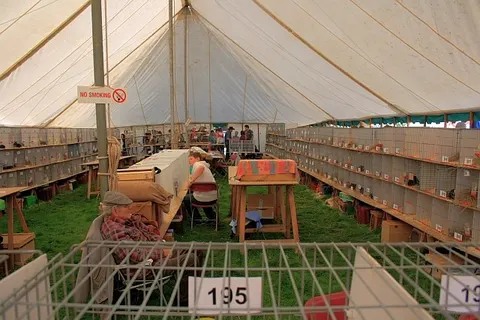

The weekend the Show comes, Stokesley changes shape. The roads fill, the field fills, and for a day the town remembers what it was built for: the business of farming, conducted in public, with prizes. It has done this, give or take a war or two, for more than a hundred and sixty years.
A meeting at the Golden Lion
The Stokesley Agricultural Society was founded at a meeting in the Golden Lion on the 12th of March 1859. It is fitting, somehow, that it began in an inn. Exactly which modern building it was is a small local puzzle: the Show’s own news page says it is now the Leven Hotel, while the Town Council’s page on the fair says it is now Chapters. We note both, and leave it to someone with the deeds to decide.
The new Show did not have long to wait for its first disaster. In late August 1866 the Leven rose and, in the words the Darlington & Stockton Times used a year later, the little town of Stokesley was “converted into a lake”. The Show was postponed. By September 1867 all was well again: the weather was all that could be desired, the field was in excellent condition, entries were up in every class, and the star of the day was a jumping horse called Topsy, who cleared the timber, the paper reported, in first-class style.
In 1866 the town was converted into a lake, and the Show had to wait.
Those early years had a way of being unpredictable in other respects too. The Group’s diary of the 1860s notes, with three exclamation marks, that in 1863 the Show was held on the 23rd of July, which was not the usual date at all.
The Workhouse Pig
The Show’s own history is generous with stories, and the best of them belongs to 1908, when the Jubilee Cup was won by a pig from the workhouse. The Stokesley Union Workhouse had been built sixty years earlier, in 1848, and for the people who lived there it was not a place associated with winning things. We know nothing more about the pig, its keeper or its later career. But it is pleasant to imagine the reaction on the showfield, and the Show tells the story still.
The Show grew up with the century. In 1929 the Black Dyke band played. In 1952 the Society had its first lady president, Mrs F. Wynne Finch, of the family who had been lords of the manor since the 1850s.
The years without
The Show has been stopped three times, and each time by something larger than the weather. It was not held from 1914 to 1919, or from 1939 to 1945; the 1939 Show was cancelled on the 2nd of September, the day before war was declared. During the later war years the town made do with Red Cross garden shows instead. Then, in our own time, Covid cancelled it again. The Show’s history page gives those lost years as 2020 and 2021; one of its news pages gives 2019 and 2020. The first is surely right, but it is a reminder that even very recent history has to be checked.
Thursday to Saturday
For more than a century the Show was held on a weekday, the third Thursday in September, which suited farmers and tradesmen and rather less suited anyone with a job in an office. In 1967 the members voted to move it to a Saturday, and from 1968 that is where it has stayed. The Show turned 150 in 2009.
It is easy to be sentimental about events like this, and the Show would probably prefer that we were not. It is a working event, with classes and judges and entry fees, and the cattle do not care how old it is. But a town that keeps coming back to the same field, every September, through floods and wars and a pandemic, is telling you something about itself. It is telling you it intends to carry on.
Sources
Every fact in this feature comes from the sources below. The prose is ours; short quotations are marked.
- History. Stokesley Agricultural Society (Stokesley Show).
- We have a great history at the Stokesley Show. Stokesley Show, 23 August 2022.
- Weather 'all that could be desired' at Stokesley Show in 1867. Darlington & Stockton Times (Chris Lloyd).
- Stokesley Fair. Stokesley Town Council.
- Stokesley Timeline. Stokesley Local History Group (Google Site).
Last reviewed 10 October 2026. Spotted a mistake or know more? Tell us.