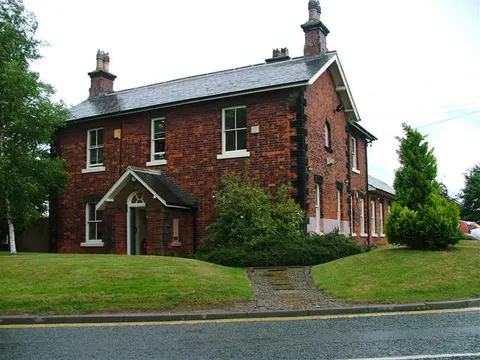

Most market towns in the North that got a railway in the 1850s were changed by it. Stokesley, on the whole, was not. The station was built about a mile to the south of the centre, at the far end of what became Station Road, and Hambleton’s planners, surveying the town in 1998, concluded that the railway had made little difference to the way it grew. The town went on being what it had always been, a place where farmers came to market. The trains simply ran past the end of it.
Ironstone and a branch line
The line was not really built for Stokesley at all. It was authorised in 1854 as the North Yorkshire and Cleveland Railway, promoted by railway companies who had their eyes on the ironstone being opened up in the Cleveland Hills. The first section, from Picton on the Northallerton to Stockton line, opened as far as Stokesley on the 3rd of March 1857. (Wikipedia says the 2nd; the railway historians at Disused Stations say the 3rd, and we follow them.) On the same day a short mineral branch opened from Potto to the Ailesbury mine near Swainby, and before long two trainloads of ironstone a day were rolling past towards the furnaces at Stockton.
From Stokesley the line pushed east, to Ingleby on the 1st of February 1858 and on to Ingleby Junction, later called Battersby, that April. It reached Castleton in 1861 and, by 1865, Grosmont and the line to Whitby, giving a through route from Stockton to the coast. The Group’s diary of the 1860s has a service to Castleton starting on the 1st of June 1860; the railway records say the Kildale to Castleton section opened on the 1st of April 1861. One of them is wrong, and it is probably the diary.
On Show day, the railway could bring a dozen excursion trains into Stokesley.
A good day out
Passenger traffic was never heavy, but there was one day in the year when that changed. The annual Show, Disused Stations records, could bring up to twelve excursion trains and a great deal of livestock. The station was built to cope: two platforms, a brick waiting shelter on each, a two-storey stationmaster’s house, and one of the bigger goods yards on the line, with a substantial goods shed and feed store, a cattle dock, coal drops and a one-ton crane.
It became part of the town’s ordinary life in other ways too. When the Methodists held a great fund-raising “Swiss Bazaar” in the Town Hall in the 1880s, a special train was laid on from Hartlepool and Stockton to bring the customers in. In 1910 five passenger trains a day ran each way between Whitby and Stockton, most of them through Stokesley.
The long goodbye
Like a great many country lines, it faded rather than died. By the early 1940s the double track west of Ingleby had been reduced to a single working line. Passenger trains west of Battersby were withdrawn in June 1954; Disused Stations gives the 14th as the closing date for Stokesley. Goods trains continued for another eleven years, latterly reached only from the Battersby end once the track towards Picton had been lifted, until the line closed completely in the summer of 1965. A railtour came through in September 1963, its locomotive running round its train at Stokesley, and somebody photographed it.
What is left
More than you might expect. The station house and buildings have been converted into offices. The goods shed and feed store were still standing, in use by a builders’ merchant, when Disused Stations visited in 2009. The signal box was moved across the road and along it to a new home in someone’s garden. And the station appears, the same site notes, in a British Transport Films production called A Farmer Moves South, which would be well worth a volunteer’s evening to track down.
The Group would very much like to hear from anyone who remembers catching a train from Stokesley, or who has photographs of the station in use. It is one of the gaps in the town’s record that living memory can still fill.
Sources
Every fact in this feature comes from the sources below. The prose is ours; short quotations are marked.
- Stokesley. Disused Stations (Subterranea Britannica).
- Conservation Area Assessment: Stokesley. Hambleton District Council, October 1998.
- The Methodist Chapels of Stokesley. Stokesley Methodist Church.
- Stokesley Timeline. Stokesley Local History Group (Google Site).
Last reviewed 10 October 2026. Spotted a mistake or know more? Tell us.