Most towns that sit on a river have a bridge they are proud of. Stokesley has several, including a packhorse bridge with a Grade II listing, but the crossings people actually talk about are the humblest ones: flat slabs laid across the Leven a few inches above the water, with nothing whatever to hold on to. The town calls them the Planks. Crossing one is called, inevitably, walking the plank.
The Group points out that such bridges are rarer than people think. In other parts of the North a single plank laid across a ditch or beck is a ligger, from ligging, the Group explains: laying a plank flat across the gap. Stokesley’s versions are more ambitious, with two or three spans resting on piers in the river, but the principle is the same. The Planks also have the distinction of a local name. Liggers belong to everybody; the Planks belong to “Stowsla”.
Four, then two
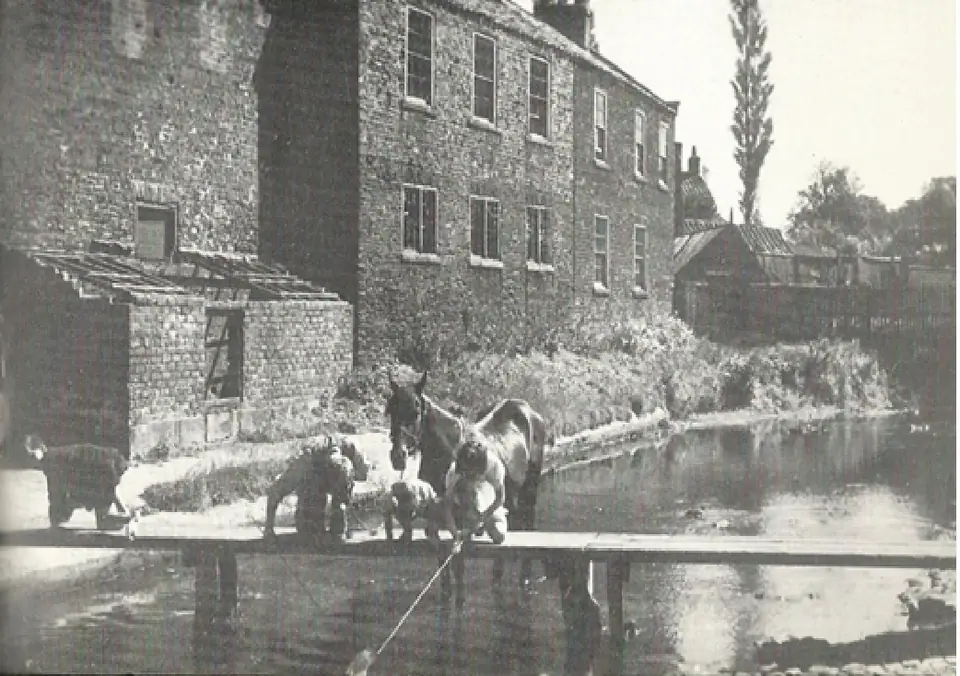
There were once four of them. One crossed the river at its last bend, where the Leven turns away from Levenside and heads off towards Bense Bridge. Another ran straight across from the back of the Bay Horse, now a coffee shop. An old photograph in the Group’s collection shows it, low and narrow, with boys fishing for tiddlers at the water’s edge; in the background, the plank behind the Golden Lion has not yet been built. Both of those have gone. The two that remain were rebuilt long ago in concrete.
The Planks had survived for years without handrails, and no great harm had come of it.
They were not always bare. The Golden Lion crossing, according to the history set out by the Town Council in 2022, began as a line of stepping stones. In the early 1900s it became a double-span wooden footbridge with handrails, and later a bridge of concrete slabs, still with rails. Then, at some point in the 1940s or 1950s, and for reasons nobody seems to have recorded, the rails came off. In the 1970s or 1980s river-narrowing work removed the northern part of the bridge altogether. What was left was a slab, and the stubs where the rails had been.
A very Stokesley argument
The question of whether to put the rails back has been running for a long time. The Group’s page records an earlier round, when Audrey Coupland organised a large petition against reinstating them. Many townspeople, the Group says, felt the exercise was not needed: the Planks had survived for years without handrails, there had been no serious accidents, and to add rails would take away something of what made them Stokesley’s own.
In December 2021 the argument came round again, this time with a planning application behind it. As part of a wider Levenside improvement scheme, Hambleton’s planning committee approved replacing the Golden Lion plank with a non-slip steel bridge with handrails, set about 200mm higher so that it would meet the new footpaths level. The council’s case was about access: people with pushchairs and wheelchairs could not use the plank and had to walk in the road to reach the next bridge.
In February 2022 residents launched a petition to save it. Teesside Live reported the comments with evident enjoyment. “Health and safety gone bonkers,” said one. Another noted that a three-year-old grandson managed the crossing without mishap. A third suggested, perhaps unwisely, that it could be crossed safely even after a few glasses of wine.
Still crossing
Later that year the Environment Agency’s flood scheme brought volunteers from the Tees Rivers Trust to Levenside to shift fifty tons of gravel into a new meander and give the river, in the Trust’s own words, some TLC. The river through the town now looks a little wilder than it did, and a little better loved.
Whatever the bridges are made of by the time you read this, the argument is the real heritage here. It is about the kind of town Stokesley wants to be: careful, certainly, but not so careful that it forgets how it used to cross its own river.
The Group's original text (unaltered)
For quite some time, discussions have been on-going regarding the re-instatement of handrails on the ‘Plank’ bridges over the River Leven. A large petition was organised by Audrey Coupland to present to the local Council. This demonstrated many of the Townspeople felt the exercise was not required. The ‘Planks’ had survived for many years without handrails and no major Health or Safety problem had been encountered. It was felt to re-instate the handrails would remove some of the ‘uniqueness’ of these Town features.
Stokesley has had 4 of these type of bridges. Two have since disappeared — the first was on the last bend of the river as it turns away from Levenside and heads off toward Bense Bridge, whilst the second was straight across the river from the rear of the Costa (used to be the Bay Horse Public House).
So that now, we have 2 left which are of a modern design — i.e. they are concrete. As originally installed, they did have handrails but these have been removed about 40 years ago. Stokesley folk ever since, have had to overcome any fears about ‘walking the Plank’.
Not many people realise such bridges are not common and are in fact, elsewhere called ‘liggers’. This coming from the basic design of laying (ligging) a plank across a ditch or small river. Stokesley seems to have developed them further to have 2 or 3 spans whereas simple liggers would be a single plank across the gap.
Stokesley folk have always called them ‘Planks’. So apart from being rare, they also have a ‘Stowsla’ name. Such features need to be preserved.
Sources
Every fact in this feature comes from the sources below. The prose is ours; short quotations are marked.
- 'Liggers' – Stokesley's Planks. Stokesley Local History Group.
- 'It's health and safety gone bonkers!' Residents launch petition to save Stokesley plank bridge. Teesside Live (Eden Lewis), 22 February 2022.
- Multi-million pound Stokesley flood scheme is complete. Environment Agency, GOV.UK, 28 September 2022.
This feature grew from the Group's own page, http://stokesleyhistory.uk/liggers.html. The Group's original wording is kept, unaltered, at the foot of the article.
How we checked this
Each claim on the Group's original page was compared with independent sources. Where they disagree we say so, and we have not changed the Group's text. See the validation log (private repository).
- Partly corroborated Stokesley had four plank bridges; two survive, in concrete. Teesside Live (2022) confirms the Golden Lion plank as a concrete slab bridge and describes its history; the count of four is from the Group alone.
- Sources disagree The handrails were removed 'about 40 years ago'. Teesside Live dates the removal of the Golden Lion plank's handrails to the 1940s or 1950s. The Group's page is undated, so the two may not truly conflict.
- Not yet corroborated Such bridges are called 'liggers' elsewhere. Plausible dialect usage (from 'lig', to lie down); a dialect dictionary reference would help.
Last reviewed 10 October 2026. Spotted a mistake or know more? Tell us.