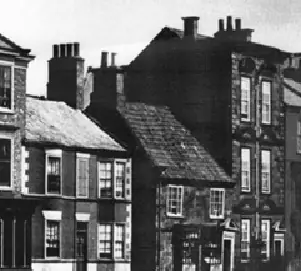
There is a particular kind of silence that follows the loss of an old building. People walk past the gap for years afterwards and find they cannot quite remember what stood there, only that something did, and that the street used to look more like itself. At the western end of Stokesley’s High Street, where it widens into West Green, the gap has long since been filled. Two neat groups of flats and the bungalows of Stone Hall Close stand there now, built, as Hambleton’s planners noted approvingly in 1998, in a way that respects local tradition. What they replaced was Stone Hall.
The Group’s account calls it the oldest and most prominent building on the High Street, and the district council’s conservation assessment dates it to the seventeenth century. The photographs in the Group’s collection show a tall, plain, many-chimneyed house, a storey higher than its neighbours, the kind of building that makes a street look settled. It had passed through the hands of the Hebdon brothers before the Stokesley Rural District Council bought it, along with the cottage and shop that stood beside it.
A house in the way
The council wanted the land more than the house. In 1968 it pulled down the cottage and the shop to make room for bungalows, and sold the Hall on to a solicitor from Middlesbrough for £1,250. He, in turn, applied to have it demolished.
This is the point at which, in a great many English towns in the late 1960s, the story would have ended. It did not end here. The Civic Society and others objected, and the Minister for the Environment refused the application. Stone Hall was to stay.
Saved on paper, it was falling down in fact.
Being saved on paper is not the same thing as being saved. The building was dilapidated and, by the Group’s account, dangerous, and the bill for putting it right was put at around £20,000, a large sum for an old house nobody seemed to want. What happened next has the shape of a parable. An anonymous donor gave the money that let the North East Civic Trust buy the property and begin the work. Nobody, as far as the Group knows, ever found out who it was. They are still asking.
Scaffolding, and then a crack
Work began in 1972. Scaffolding went up, the front was made safe, and the roof was repaired so that, for the first time in years, the rain stayed out. And then, during that further work, the men on site noticed that the structure was moving.
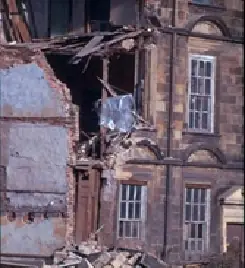
They did the sensible thing and fenced it off. Two days later, a corner of Stone Hall collapsed into the street.
The only way to keep what was left was to underpin it, and the cost of that was prohibitive. The house that had seen off a demolition application was taken down after all.
Which year?
Here the record becomes untidy, in a way that will be familiar to anyone who has tried to pin down something that happened within living memory. The Group’s own page gives the collapse as 1975. Hambleton’s 1998 conservation assessment, and the chronology compiled by the Cleveland and Teesside Local History Society, both say Stone Hall was demolished in 1973. And a timeline on the Group’s own Google Site records, under 1970, that “Stone Hall and Brewery Terrace” were demolished and flats created.
All three cannot be right. It is quite possible that the dates refer to different moments in a long, slow ending: the first clearances, the collapse, the final demolition. A dated report in the Evening Gazette or the Darlington & Stockton Times, or the Trust’s own papers, would settle it, and that is exactly the sort of research the Group does best. Until then, this feature follows the Group’s account and says plainly that the date is in doubt.
The tunnel that was never found
Old buildings collect stories, and Stone Hall was no exception. The Group’s collection of local ghost lore records a long-held belief that a passage ran underground from the church to Stone Hall, used, inevitably, by smugglers, and that the house had a ghost which generations of local children went looking for. No passage was ever found, and the ghost, the Group notes drily, was never seen. It is a legend, and we report it as one. But it tells you something true all the same: that for a long time, this was the house in Stokesley that people told stories about.
Do you know more?
The Group would like to hear from anyone who remembers the collapse, who knows the year for certain, or who can name the anonymous donor. Photographs of Stone Hall before it came down are especially welcome. Share a memory or photograph.
The Group's original text (unaltered)
Until 1975, on the site now occupied by Stone Hall Close and adjacent flats, stood Stone Hall, the oldest and most prominent building on the High Street.
Previously owned by the Hebdon Brothers, it was purchased by Stokesley Rural District Council, who, in 1968, demolished the adjoining cottage and shop to build bungalows in Stone Close, selling on the Hall to a Middlesbrough solicitor for £1,250.
He applied to have it demolished but following opposition from the Civic Society and others, the Minister for Environment refused the application.
However the building was in a dilapidated and dangerous condition with an estimated £20,000 needed to renovate it. The problem appeared to be solved when a donation from an anonymous donor enabled the North East Civic Trust to purchase the property and start renovations. (Did anybody discover the identity of the donor?)
Work started in 1972 with scaffolding erected. The facia was made safe and the roof repaired to make it waterproof.
In 1975 whilst undergoing further work, workmen noticed movement in the structure and promptly cordoned off the building. Two days later a corner collapsed into the street below.
The cost of underpinning was prohibitive, leaving no alternative but complete demolition.
Then and now
Modern photograph from the same viewpoint needed: a volunteer task.
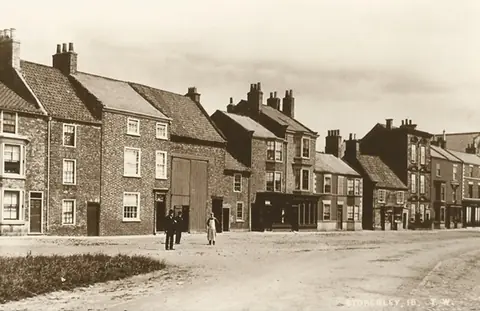 Then
Then Sources
Every fact in this feature comes from the sources below. The prose is ours; short quotations are marked.
- The Collapse of Stone Hall. Stokesley Local History Group.
- Conservation Area Assessment: Stokesley. Hambleton District Council, October 1998.
- Fifty Interesting Places: Stokesley. Cleveland & Teesside Local History Society.
- Stokesley Timeline. Stokesley Local History Group (Google Site).
- Ghosts and Legends. Stokesley Local History Group.
This feature grew from the Group's own page, http://stokesleyhistory.uk/stonehall.html. The Group's original wording is kept, unaltered, at the foot of the article.
How we checked this
Each claim on the Group's original page was compared with independent sources. Where they disagree we say so, and we have not changed the Group's text. See the validation log (private repository).
- Sources disagree Stone Hall was demolished in 1975. The 1998 conservation assessment and the CTLHS chronology both give 1973; the Group's own Google Site timeline gives 1970. Needs a dated newspaper report or council minute to settle.
- Partly corroborated It was the oldest building on the High Street. The conservation assessment calls it 17th-century and says flats at 56–58 High Street replaced it. Whether it was the oldest is not tested by any other source.
- Not yet corroborated The North East Civic Trust bought it after an anonymous donation; the Minister refused demolition. No independent source found online yet. The Trust's own archive or the planning file would confirm it.
Last reviewed 10 October 2026. Spotted a mistake or know more? Tell us.