The Manor House sits at the quiet, eastern end of Stokesley, behind a brick wall, beside the church, looking out across the Plain. It is the kind of house a town takes for granted: the lords of the manor lived in it, then the council used it, then the library, and for most of its life its business was its own. But for four years at the beginning of the last century, it belonged to everyone.
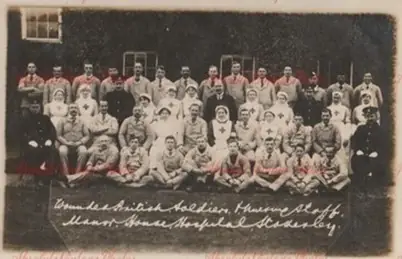
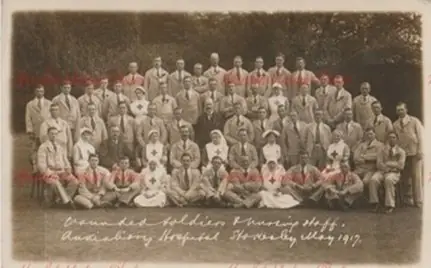
In the autumn of 1914, by the account the Stokesley Heritage researchers found in the North Eastern Daily Gazette, the Wynne-Finch family offered their house to the war effort. It was a larger building then than now: four bays at its southern end were pulled down after the Second World War. Two wards were made ready, sixty beds set out, and on the 28th of October the first patients arrived. They were fourteen Belgian soldiers. Among the surviving photographs is one picture of the nursing staff with exactly fourteen men who are not in British uniform, and the researchers have wondered, reasonably, whether these are they.
The commandant
The hospital had a commandant before it had patients. Anne Gatenby Gjers had been a stalwart of the North Riding Red Cross for years and led the local Voluntary Aid Detachment, known in the record by the unlovely name of Yorks/42. Her father, Isaac Fidler, had been Mayor of Middlesbrough and laid the foundation stone of the town’s new town hall in October 1883. She herself would later be appointed OBE. The Group’s page describes her as the wife of Lawrence Gjers, JP; the North Riding VAD project calls her the widow of John Gjers of the shipping firm Gjers, Mills & Co. The sources disagree, and we leave the question open.
What nobody disputes is that she was good at it. She understood, earlier than many, that a voluntary hospital lives on goodwill, and that goodwill must be fed. She wrote to the local papers and the parish magazine, and she listed every gift and every giver: hares and pheasants from the big houses, stock from the shops, knitting and sewing from the work-parties, pennies collected by schoolchildren.
She listed every gift and every giver, down to the schoolchildren’s pennies.
The workmen of Gjers, Mills & Co.’s Ayresome Ironworks were so taken with a concert in the Manor House grounds in the summer of 1916 that they agreed, on returning to the works, to have at least a penny-halfpenny a week stopped from their wages. Between August 1916 and April 1919 the fund raised £458 15s 4d, which the firm doubled.
The women of the town
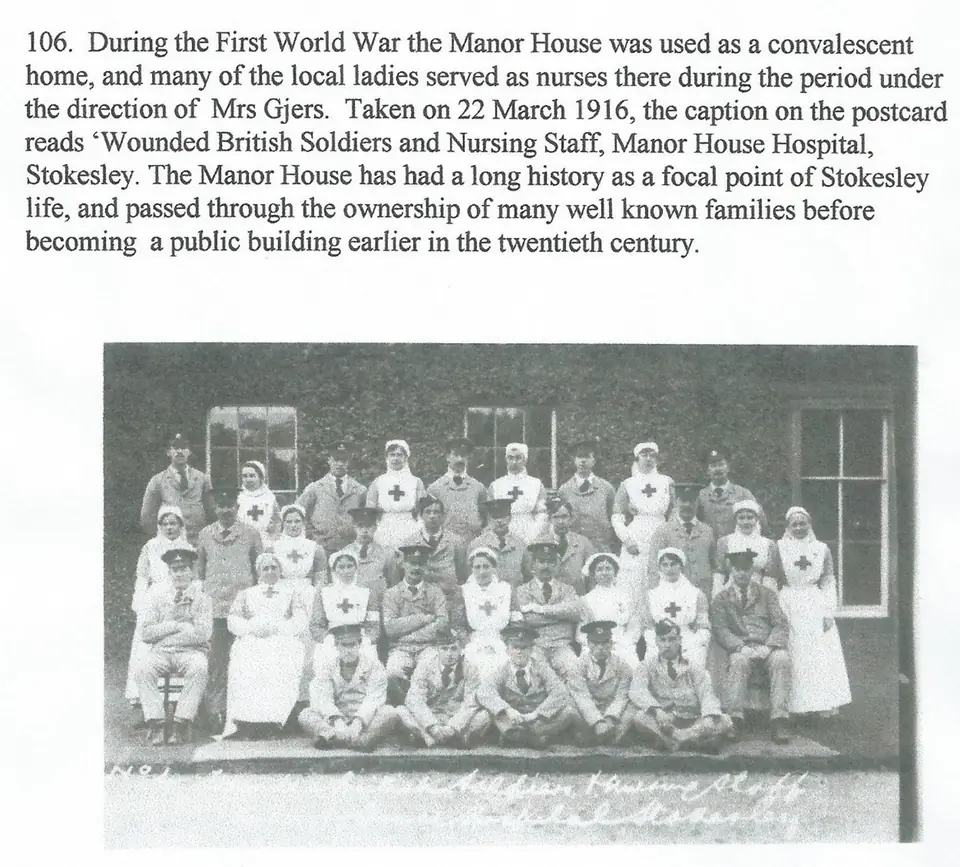
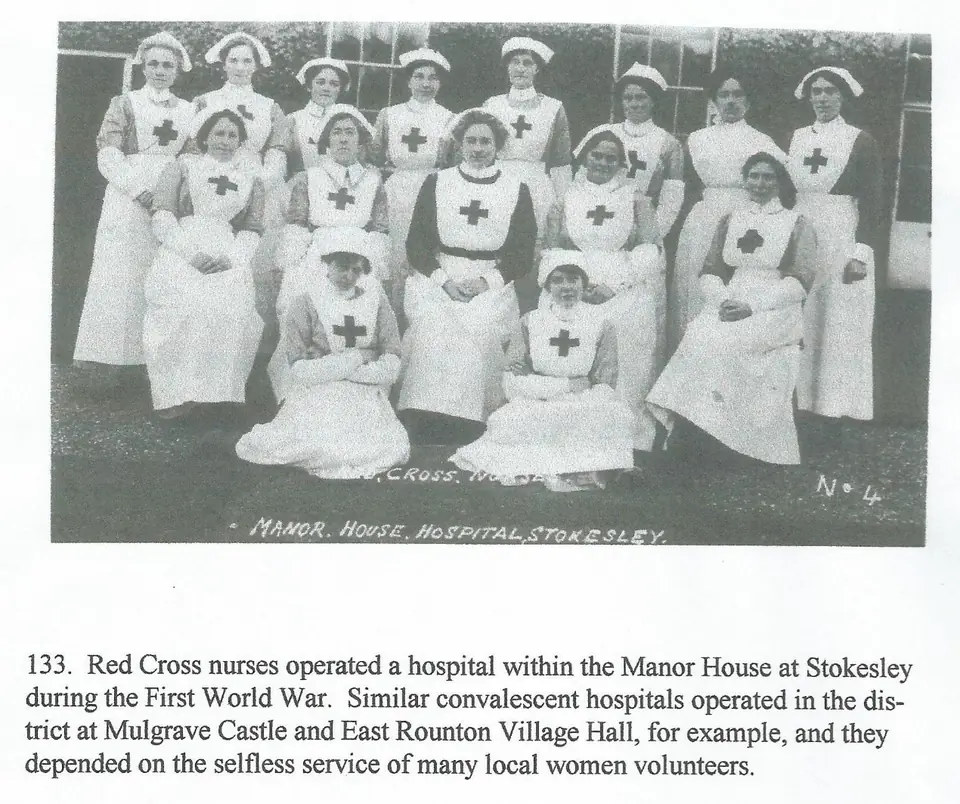
The detachment’s photograph, taken behind the house and later given to the library, is a portrait of a whole district in uniform. The names, recovered by the late Miss Seaton and others, read like a directory of Stokesley and its neighbours: Clara Barker, the quartermaster, whose father sold jewellery, bicycles and motor cars; Louie Goldsborough, a music teacher who lived on West Green; Olga Gjers, the commandant’s daughter; the vicar’s wife and eldest daughter from Carlton; a cook, two maids and two children’s nurses from Busby Hall; and the Richardson sisters of Potto Hall.
Only one of them was a qualified nurse. Rachel Crosby Grainger was born in Hartlepool in 1887, the daughter of a butcher who sat on the town’s first council. She was the only trained nurse on the staff, and in photograph after photograph she sits beside the commandant, which the researchers take, kindly, as a sign that the old friction between professional nurses and well-born volunteers never took hold here. After the war she married John Foster Ellerby, a bank clerk who lived at Brook House in Stokesley, and gave up nursing, as married women then did. Her son remembered her telling him about afternoon teas for the convalescent men at Kildale Hall, Busby Hall and Potto Hall.
Christmas at Potto
One such tea, at Potto Hall at Christmas 1916, had sketches, songs and piano duets put on by the Misses Richardson and their friends. A year later, Gwendoline Richardson was on duty at the hospital on Christmas Day, fell ill with pneumonia, and died. The Middlesbrough Daily Gazette reported her death on the 8th of January 1918, and noted that the wounded men had sent flowers. Her name is among the women commemorated in York Minster for their service in the war.
The men did their part too. The Men’s Detachment, Yorks/19, mobilised in June 1915 with thirty-eight members, served as night orderlies and stretcher-bearers through the war; by 1918 only four were left. Dr William Metcalf Yeoman, Stokesley’s own doctor, was medical officer, and, the researchers note with some amusement, a generous donor of cigarettes.
Eight hundred and one
By the time the hospital closed in 1919, 801 men had passed through it. Very few were local. The Stokesley historian Charles Hall noted only one Stokesley man among them, Benjamin Rowland Robson; the Heritage researchers have since found a second, Albert Exelby, photographed in the grounds in 1916.
It is said, and it is the kind of thing that is always said, that wounded men in France were told to try to get themselves sent to Stokesley because the hospital there was “brilliant”. We cannot prove it. But the letters the soldiers wrote afterwards survive, and so do the photographs, rows of men in uniform beside women in white, outside a house that, for four years, the whole town had kept warm.
Further reading
- Stokesley Heritage wiki: Manor House Hospital, with the story of Stokesley’s fallen researched by Val and Keith Burton.
- North Riding VAD Hospitals: Stokesley, with notes on every named volunteer.
The Group's original text and transcribed exhibition panels (unaltered)
During World War I, the Manor House was given over to the service and care of wounded soldiers. Ann Gatenby Gjers of Busby Hall was the wife of Lawrence Gjers, JP for Middlesbrough and the North Riding of Yorkshire, Colonel and Commandant of the North Riding National Reserve. Her father Isaac Fidler was an alderman in Middlesbrough and had laid the foundation stone of Middlesbrough’s new town hall on 24th October 1883 when he was Mayor.
He was also Vice President of the North Riding branch of the British Red Cross Society and Commandant of the Red Cross Hospital, set up at the Manor House in Stokesley. Ann Gatenby Gjers worked alongside her daughter Olga. She later was awarded the OBE.
Her son Lawrence was killed in action during the Battle of the Somme.
Exhibition panel 106 (transcribed)
During the First World War the Manor House was used as a convalescent home, and many of the local ladies served as nurses there during the period under the direction of Mrs Gjers. Taken on 22 March 1916, the caption on the postcard reads ‘Wounded British Soldiers and Nursing Staff, Manor House Hospital, Stokesley’.
The Manor House has had a long history as a focal point of Stokesley life, and passed through the ownership of many well known families before becoming a public building earlier in the twentieth century.
Exhibition panel 133 (transcribed)
Red Cross nurses operated a hospital within the Manor House at Stokesley during the First World War. Similar convalescent hospitals operated in the district at Mulgrave Castle and East Rounton Village Hall, for example, and they depended on the selfless service of many local women volunteers.
Sources
Every fact in this feature comes from the sources below. The prose is ours; short quotations are marked.
- Manor House Hospital. Stokesley Local History Group.
- Stokesley Manor House Hospital. Stokesley Heritage (wiki).
- Home Comforts: Manor House Hospital, Stokesley. North Riding VAD Hospitals project.
- 'Parishes: Stokesley', VCH North Riding vol. 2. Victoria County History, via British History Online, 1923.
This feature grew from the Group's own page, http://stokesleyhistory.uk/manorhosp.html. The Group's original wording is kept, unaltered, at the foot of the article.
How we checked this
Each claim on the Group's original page was compared with independent sources. Where they disagree we say so, and we have not changed the Group's text. See the validation log (private repository).
- Corroborated A Red Cross hospital operated in the Manor House during the First World War. Confirmed by the Stokesley Heritage wiki and the North Riding VAD Hospitals project, which add the dates (October 1914 to 1919), 60 beds and 801 patients.
- Sources disagree Ann Gatenby Gjers was the wife of Lawrence Gjers. The Stokesley Heritage wiki agrees; the North Riding VAD project calls her the widow of John Gjers of Gjers, Mills & Co. Needs checking against a marriage record.
- Not yet corroborated 'He was also Vice President of the North Riding branch of the British Red Cross…' The original sentence is ambiguous. An online summary we could not open directly describes Mrs Gjers herself as vice-president of the North Riding branch, which would resolve it; a volunteer should confirm.
- Not yet corroborated Her son Lawrence was killed in action during the Battle of the Somme. The VAD project says only that Mr L. F. Gjers, commandant of the men's detachment, 'was reported to have died in 1918'. CWGC records should be checked.
- Not yet corroborated The postcard photograph is dated 22 March 1916. Comes from the Group's own exhibition panel; no other source checked.
Last reviewed 10 October 2026. Spotted a mistake or know more? Tell us.