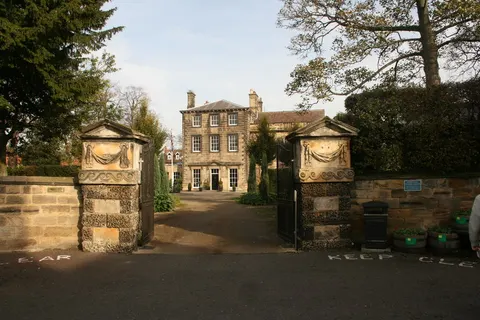

Stand on the Plain, at the eastern end of the High Street, and look past the Town Hall towards the Manor House behind its wall. The house you see is mostly eighteenth-century, a long, plain stone building in its own wooded grounds, but there has been a manor house on or near this spot for a very long time. The Victoria County History, writing in 1923, says it once deserved the name of a castle. The men and women who owned it owned, in a legal sense, the town: its market, its courts, its mill, and a great deal of its land. Their story is not the whole story of Stokesley. But for most of the town’s history it is the part that was written down.
Before and after the Conquest
In 1066 the manor belonged to a man called Hawart, with six carucates of land: enough, in the arithmetic of the time, to keep six ploughs busy. Twenty years later, when the Domesday commissioners came, it was held by Uhtred, described as the king’s thegn, and its value had fallen from £24 to £8. Stokesley was already the centre of something larger, with rights over land in Skutterskelfe, Ingleby Greenhow, Tanton, the Busbys and half a dozen other places.
Probably in the reign of William Rufus, the barony passed to Guy de Balliol, the founder of a family that would one day give Scotland a king. Guy gave the parish church to St Mary’s Abbey at York. His descendants held Stokesley for a century and a half, and the County History, which rarely allows itself a flourish, permits one here: in 1168 the younger Bernard de Balliol was fined £20 for failing to produce the charters by which he held his lands.
The Eures
The Balliol overlordship lasted until 1296, when John Balliol, briefly King of Scots, forfeited it. By then the land itself had passed through Hugh de Balliol’s daughter Ada to her younger sons Robert and Hugh, who took the name Eure. They did not wait politely for their inheritance. In the summer of 1250 their mother enfeoffed them, and they at once appointed their own steward and reeves, threw out hers, and began holding courts and collecting fines. A few months later they gave the manor back to her for life. One would very much like to know what was said at dinner.
They appointed their own steward, threw out their mother’s, and began holding courts.
The Eures held Stokesley for nearly four hundred years, a regular succession, as the County History puts it, of Ralphs and Williams. They were a northern fighting family and it shows in the record. One John de Eure was killed at Auckland before 1322 “by certain malefactors”. Ralph Eure was killed at Towton in 1461, in the Wars of the Roses. In 1544 Sir William Eure was made a peer, as Lord Eure, and his son Ralph was killed at Ancram Moor, on the Scottish border.
A Catholic and a king
In about 1622 or 1623, William, Lord Eure sold Stokesley to Richard Forster. Forster was a recusant, a Catholic who would not attend the parish church, and he paid for it: two-thirds of the manor were seized by the Crown for arrears of his fines, and leased back to him and his son in 1637 for £5 a year. During Charles II’s exile Forster served as the king’s treasurer, and in 1649 he was made a baronet.
The Catholic lords of Stokesley kept a chapel, the “mass house”, probably beside the manor house. It did not make them popular. In 1746 the boys of the town attacked it in force, plundered the chapel and burnt what they took around the market cross. By then the manor had passed through the Collingwoods to William Peirson of London and his son Bradshaw Peirson, who died unmarried that same year.
Hildyards and Wynnes
In 1799 the Peirson estates were broken up and sold. The manorial rights and the house went to Thomas Wilkinson, who sold them on, before 1808, to the Rev. Henry Hildyard. The house, which had fallen into some decay, was restored. Henry’s son, Lieutenant-Colonel Robert Hildyard, was lord by 1846; it was he who swept away the old toll-booth and built the Town Hall in 1853.
The last chapter in the County History has the ring of a Victorian novel. Robert Hildyard left the manor to his nephew, Major Heneage Wynne. The major was killed at Inkerman, in the Crimea, a few days after his uncle died, and the estate passed instead to his father. Heneage’s brother Charles, who took the additional surname of Finch in 1863, succeeded in his turn. The County History closes, in 1923, with Edward Heneage Wynne-Finch as lord of the manor.
It was the Wynne-Finch family who, in the autumn of 1914, offered the house as a hospital for the wounded of another war. After the war the Gjers family bought it. Four bays at its southern end were later pulled down, and for much of the twentieth century it served the public, as council offices, court and library. The lords of the manor had gone. The house, and the market they had fought over, remained.
Sources
Every fact in this feature comes from the sources below. The prose is ours; short quotations are marked.
- 'Parishes: Stokesley', in A History of the County of York North Riding, vol. 2, ed. William Page. Victoria County History, via British History Online, 1923.
- Stokesley | Domesday Book. Open Domesday (Anna Powell-Smith).
- Conservation Area Assessment: Stokesley. Hambleton District Council, October 1998.
- Stokesley Manor House Hospital. Stokesley Heritage (wiki).
Last reviewed 10 October 2026. Spotted a mistake or know more? Tell us.