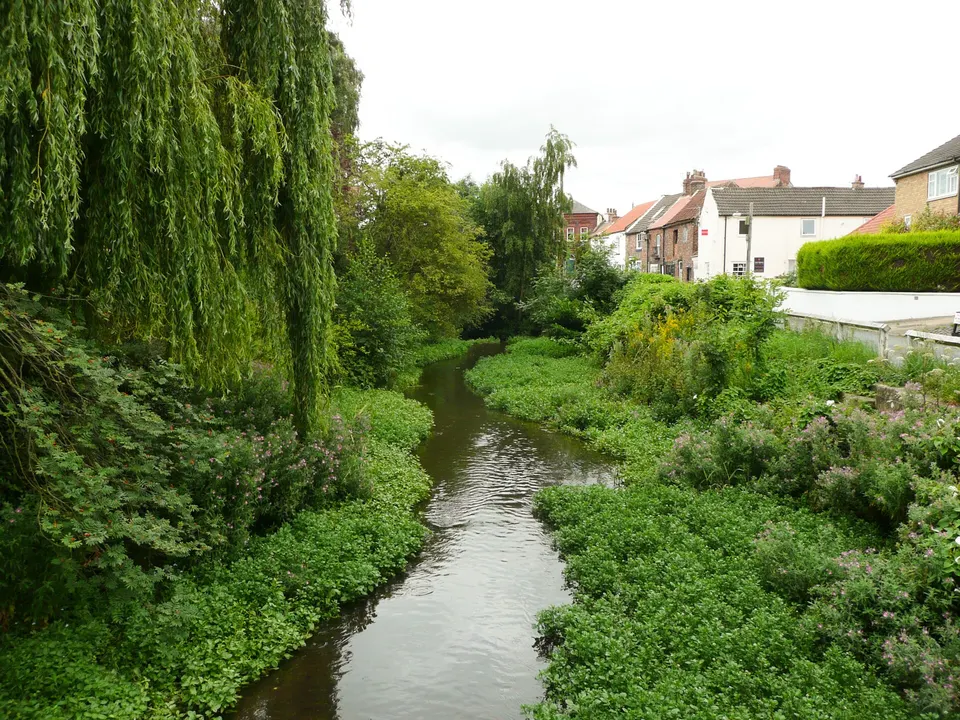

There is a line of trees on South Levenside that most people walk past without a second glance. They were planted in 1934, the Cleveland and Teesside Local History Society records, in memory of a woman called Jane Pace. Hardly anyone in Stokesley now could tell you who she was. In the state of Victoria, on the other side of the world, she is a founding figure.
The captain’s daughter
Jane was the daughter of Walter Pace, a captain in the service of the East India Company, and his wife Elizabeth. Every Australian account of her that we have found says she was born in Stokesley; one spells it “Stokesby”, which is close enough. When she was born is a small mystery of its own. A Fremantle history site, quoting a Victorian family-history source, gives the 8th of February 1816, and a genealogy site says her headstone agrees; the same Fremantle page, in its own record of the family, gives 1818. A short biography on a Victorian local-history site says the 8th of February 1817, which is also the year the State Library of Victoria uses, and then, a few paragraphs further on, that she was born in Yorkshire on the 14th of April 1812. The genealogy site also reports a christening at Seamer, just outside Stokesley, in January 1816, which would mean she was baptised before she was born. The parish registers of Seamer and Stokesley should be able to settle it, and it would make a good afternoon’s work for a volunteer.
Captain Pace already knew the way. He had first arrived at the young colony at the Swan River in Western Australia in 1830 as master of an emigrant ship, the Medina. In 1832 he went back to stay, took land in Fremantle, built a stone house and wrote home that he would return for the family. His wife, the Fremantle account says, did not wait. Without telling him, she took her daughters Jane and Ann aboard a ship called the Quebec Trader and sailed for Fremantle, by way of friends in South Africa. They landed at Fremantle in April 1834, and Walter Pace was, we are told, much surprised to see them. Mrs Pace went on to keep a store and a boarding house there, on a site that has been a hotel ever since.
There is one more family story, which the Fremantle site repeats and we pass on strictly as tradition: that Captain James Cook’s mother, Grace Pace, was of the same family. Cook grew up at Great Ayton, a few miles from Stokesley, so it is a pleasing thought. Nobody, as far as we know, has proved it.
Stephen Henty
In Western Australia the Paces met the Hentys, a large, ambitious Sussex farming family who had come out in 1829 with flocks of merino sheep and a great deal of capital, and had quickly decided that the Swan River country was too poor to farm. Stephen George Henty was one of seven brothers. He had tried farming, then turned to trading between Fremantle and Launceston in Van Diemen’s Land. According to one account, he was among the small group of colonists who rowed out to meet the Quebec Trader when she anchored off Fremantle, and Jane was engaged to him almost at once. They married at Fremantle in April 1836. She was, by the State Library’s reckoning, eighteen.
She is believed to be the first European woman to settle permanently in what became Victoria.
In 1834 his brother Edward had landed at Portland Bay, on the southern coast of what was then the unauthorised, almost unknown Port Phillip District, and begun farming there without the government’s permission. In December 1836 Stephen and Jane followed him. She remembered the landing for the rest of her life. It was a Sunday night, and moonlit; a sailor carried her through the surf onto the beach; and at the homestead there was a log fire burning and a table laid with bread, butter, a pile of eggs and tea. Her brother-in-law Frank met her at the door and welcomed her as “Mrs Stephen”. She corrected him: her name, she told him, was Jane Henty, and she was his sister. She is believed, the State Library of Victoria says, to have been the first European woman to settle permanently in what became Victoria.
A life at Portland
The Australian Dictionary of Biography, writing about the family as a whole, is clear that Stephen was the backbone of the new settlement: merchant, shipowner, whaler, explorer and magistrate, and later a member of Victoria’s Legislative Council. It gives Jane one sentence of her own, and makes it count. She was the mother of ten children before she was forty, and she, too, “played a notable part”. The family later lived at Findon, the house Stephen built in Melbourne, until his illness brought them back to the country. He died near Hamilton in 1872. Jane outlived him by more than thirty years, dying at Hamilton in February 1906.
It is the usual fate of the women in these stories to appear mainly in the footnotes of their husbands’ lives, and the State Library’s own blog post about her says as much: we know their births and deaths, and much less about what happened in between. Jane did leave her own account, a little booklet called Old Memories, written on her eighty-fourth birthday. Stokesley has never, as far as we know, had a copy. One day someone should bring it home.
The trees
Why the trees were planted in 1934, and by whom, the record we have does not say. It may have been a centenary of sorts; 1934 was a hundred years after the Hentys first landed at Portland Bay. It may have been the work of a visitor from Victoria, or of someone in the town who had read about her. It is another question for the Group’s files. For now, it is enough to know that the line of trees on South Levenside is a memorial, and to whom.
Sources
Every fact in this feature comes from the sources below. The prose is ours; short quotations are marked.
- What about the women? Part 1. State Library Victoria.
- Henty family, by Marnie Bassett. Australian Dictionary of Biography, ANU, 1966.
- Stephen George Henty 1811–1872. South-West Victoria (swvic.au).
- Pace. Freotopia (Fremantle history).
- Jane (Pace) Henty. WikiTree (collaborative genealogy; used as a pointer only).
- Fifty Interesting Places: Stokesley. Cleveland & Teesside Local History Society.
Last reviewed 10 October 2026. Spotted a mistake or know more? Tell us.