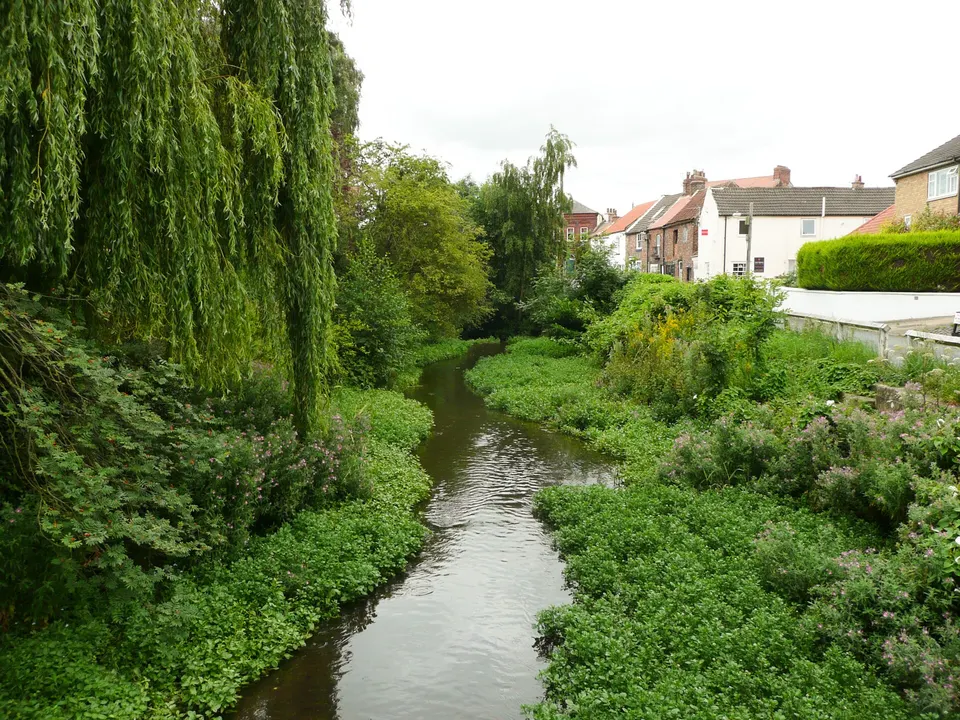
On a summer afternoon the Leven at Stokesley is a river for paddling in. It runs shallow and brown over gravel, between grass banks and old trees, past the backs of the houses on Levenside and under its assortment of bridges, and on a warm day it all but invites you to take your shoes off. It is hard, on such a day, to believe the town has spent two hundred years being frightened of it.
But the town is built where it is because of the river, on its north bank, close to the water, and the price of that has always been paid every few decades in mud. The Group thought the subject important enough to give it a whole book: Climate or Weather: Stokesley Survives, published in 2024.
A town converted into a lake
The earliest flood in the local chronologies is 1817, remembered simply as severe. The Group’s diary of the 1860s is a long litany of weather: a summer in 1860 when it rained almost without stopping for three months; heavy rain and flooding at the end of September 1863. And then the 29th of August 1866, when, the diary says, Stokesley was completely under water. The same storm damaged the bridges on the Esk and the fishing fleet at Whitby.
The Show, due a few weeks later, had to be postponed. A year on, the Darlington & Stockton Times opened its report of the 1867 Show by reminding readers that, the previous year, owing to heavy rains, “the little town of Stokesley was converted into a lake”. It is one of those phrases that tells you more than a rainfall figure ever could.
The little town of Stokesley was converted into a lake.
The twentieth century
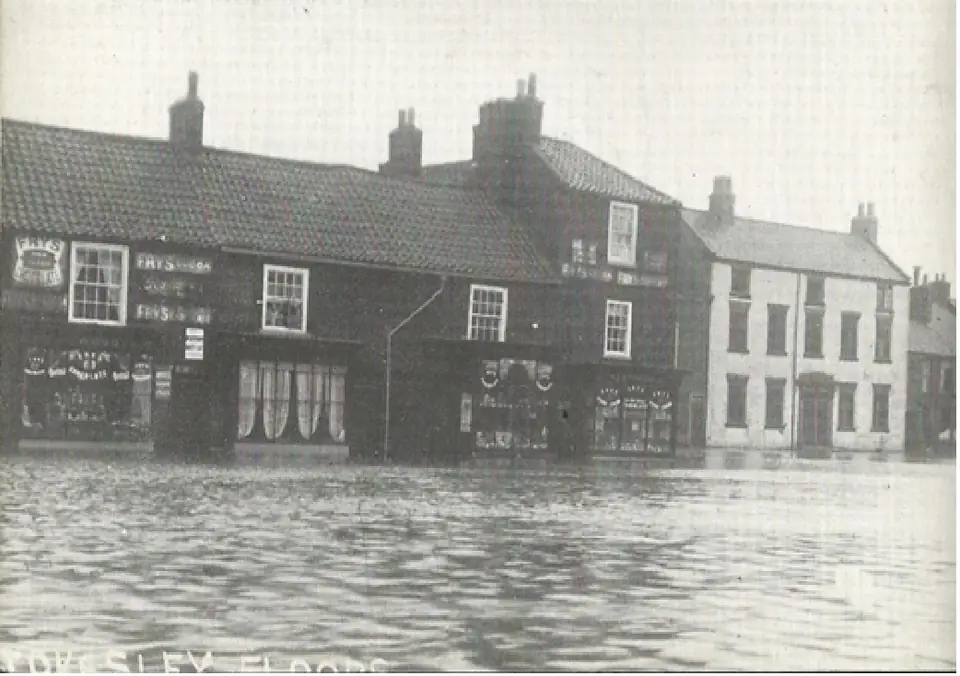
The floods kept coming. In July 1930 heavy rain put the High Street under water. In August 1954, the diary notes, the river overflowed and West Green flooded, an event the Evening Gazette thought worth a report. The undated photograph from the Group’s gallery at the top of this page, of a row of houses at the West End standing in water, could belong to almost any of them.
The flood that changed things came in 1976. In its wake a diversion channel was built to carry high water around the town rather than through it, and a control system to go with it, finished, by the local chronology’s account, about two years later.
New gates for an old river
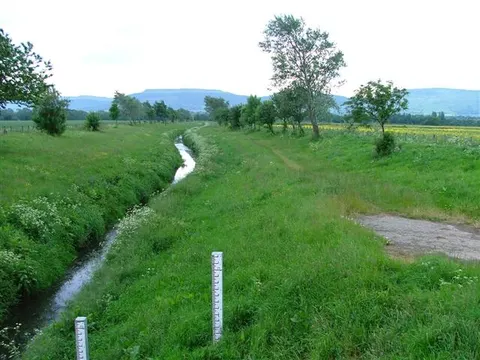
That system served for more than forty years. In autumn 2020 the Environment Agency began to rebuild it, and by August 2022 the work was done, at a cost of more than £3.7 million. Upstream, a new structure now watches the level of the Leven and, when it rises, automatically turns the extra water away down the re-profiled diversion channel. Downstream, a second structure has side-hung doors that close in high water, so that the Eller Beck cannot push back up the Leven into the town. The scheme protects 509 homes and businesses.
The engineering was only half of it. On Levenside the Tees Rivers Trust and a crowd of volunteers moved fifty tons of gravel into a new meander, added deflectors and a fish pass, and gave the river a more natural shape through the town. Local businesses, the Trust reported, kept the volunteers going with coffee and chips. The scheme was formally opened on Friday the 23rd of September 2022.
Nobody who knows the Leven would claim it has been tamed. But for the first time in its long history, the town has a say in where the river goes when it rises, and the river, on a summer afternoon, looks better for it.


Sources
Every fact in this feature comes from the sources below. The prose is ours; short quotations are marked.
- Fifty Interesting Places: Stokesley. Cleveland & Teesside Local History Society.
- Stokesley Timeline. Stokesley Local History Group (Google Site).
- Weather 'all that could be desired' at Stokesley Show in 1867. Darlington & Stockton Times (Chris Lloyd).
- River Leven, Stokesley. fhithich.uk (blog), 19 August 2020.
- Multi-million pound Stokesley flood scheme is complete. Environment Agency, GOV.UK, 28 September 2022.
- Group Publications. Stokesley Local History Group.
Last reviewed 10 October 2026. Spotted a mistake or know more? Tell us.