

The roads of Cleveland, the Victoria County History observed in 1923, all meet at Stokesley. What it did not need to add was that most of them, sooner or later, have to cross the Leven. The river runs along the south side of the town, close behind the houses, and the history of how people have got over it is very nearly the history of the town itself.
The packhorse bridge
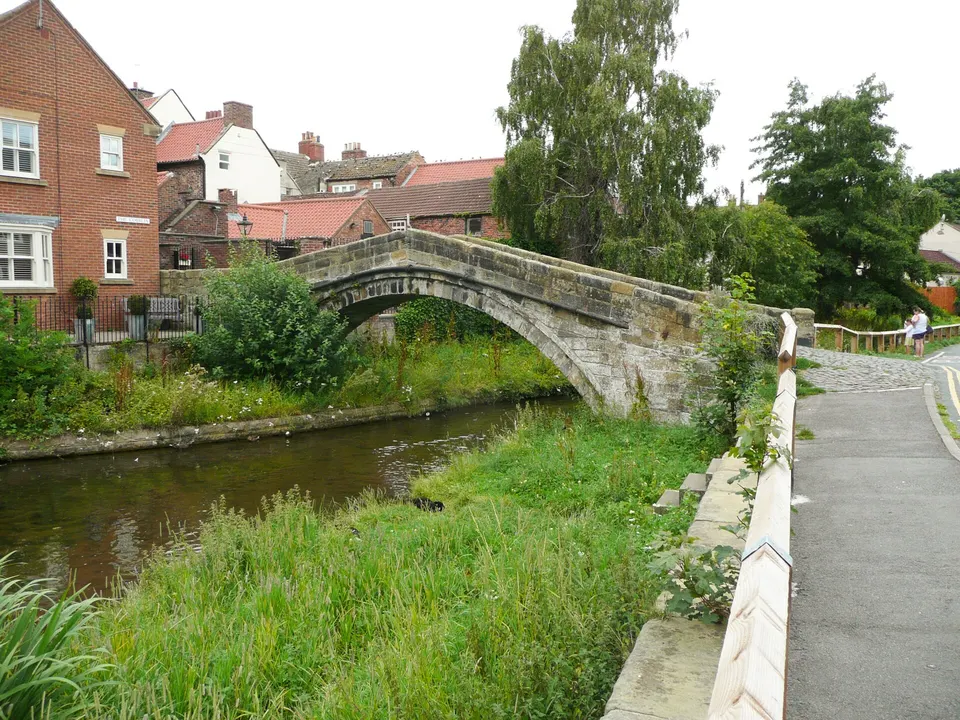
The oldest crossing still standing is the Packhorse Bridge, also known as Taylorson’s Bridge, a few steps south of the Market Place. It is a narrow hog-backed bridge of coursed stone, with high parapets over a single round arch whose stones were cut to shape, and a dripmould above to throw off the rain. It was listed at Grade II in June 1966. When it was built is anybody’s guess, and Historic England’s guess is a cautious one: the seventeenth or early eighteenth century.
The lane that leads to it, the district council’s planners noted in 1998, was once the main road to Kirby, Great Ayton and Guisborough, and the town’s market cross stood near its top until it was taken down in 1780. So this was not a backwater. Anyone setting out from Stokesley for Great Ayton or Guisborough, on foot or with a laden horse, would have come this way.
There is a tantalising earlier reference. In 1648 the North Riding magistrates ordered the inhabitants of Stokesley to repair a structure called “Stoxley-becke bridge”. The County History thought it was probably the old stone footbridge. If so, the bridge, or an earlier one on the same spot, was already in need of attention in the middle of the seventeenth century. If not, it was another bridge altogether, now lost. We cannot say which.
Each generation crossed the river in its own material: stone, then iron, then concrete.
Road bridges and an iron one
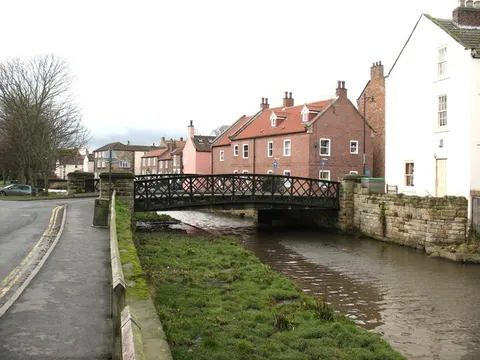
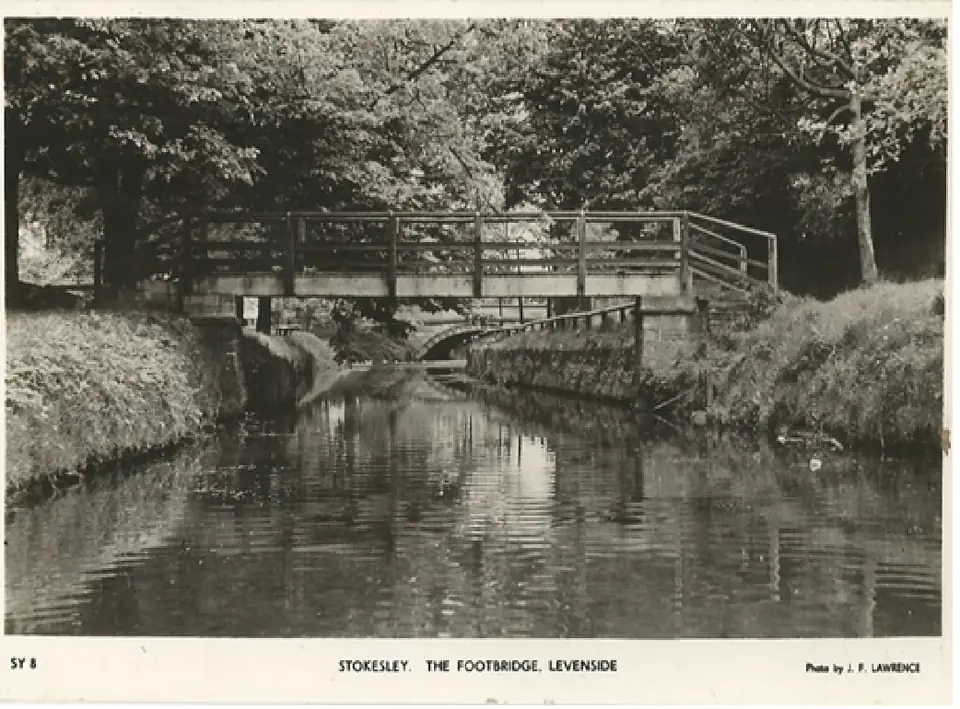
For wheeled traffic, the town needed something stronger. The local chronology compiled by the Cleveland and Teesside Local History Society records a town bridge built in 1784, an iron footbridge put across the river in 1885, and a new town bridge in concrete in 1957. The iron bridge is still there on Levenside. Add to these the Planks, the low slab bridges the town has argued over for generations, and the bridge by the church, and you have a town that has never been short of ways over its river, only of agreement about what they should look like.
The mill by the bridge
Where there is a river and a market, there is a mill. Domesday Book recorded one at Stokesley in 1086, worth ten shillings a year. In 1717 the mill-house was described as containing “three water corn milnes and one horse milne all within one house”, which the County History identified with the corn mill that still stood in 1923 on a backwater of the Leven just east of the town bridge. The Group’s diary of the 1860s mentions an “old corn mill” whose roof had been destroyed by fire, possibly a mill of the seventeenth century.
Its last name was Fiddler’s Mill. The Show’s history, which has a particular fondness for it, says it was probably on the site of the Domesday mill, that it last worked around 1945, and that it was demolished in 1983. In August 1988 the Stokesley Society set up the old mill wheel beside the town bridge as a memorial. The Group’s own online timeline has a slightly different version, with the mill demolished in 1989 and the wheel unveiled in 1992. The wheel, either way, is still there, turning nothing, a reminder that for perhaps nine centuries this was where the town’s corn was ground.
Then and now
The old photograph below, from the Group’s gallery, shows the Packhorse Bridge as it once was. The modern view is from a slightly different spot. Getting the two to line up would make a pleasant job for anyone with a camera and a fine afternoon.
Then and now
 2020
2020 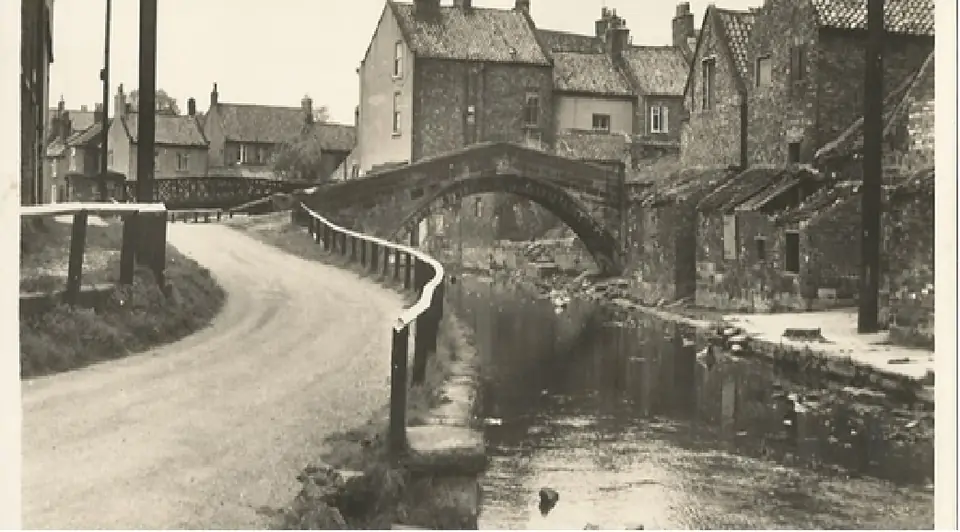 Then
Then Sources
Every fact in this feature comes from the sources below. The prose is ours; short quotations are marked.
- Packhorse Bridge, Stokesley (List entry 1150225). Historic England, listed 23 June 1966.
- Packhorse Bridge, Stokesley (list description). British Listed Buildings (text of the Historic England entry), amended 28 July 2023.
- 'Parishes: Stokesley', VCH North Riding vol. 2. Victoria County History, via British History Online, 1923.
- Stokesley | Domesday Book. Open Domesday (Anna Powell-Smith).
- Conservation Area Assessment: Stokesley. Hambleton District Council, October 1998.
- Fifty Interesting Places: Stokesley. Cleveland & Teesside Local History Society.
- History. Stokesley Agricultural Society (Stokesley Show).
- Stokesley Timeline. Stokesley Local History Group (Google Site).
Last reviewed 10 October 2026. Spotted a mistake or know more? Tell us.