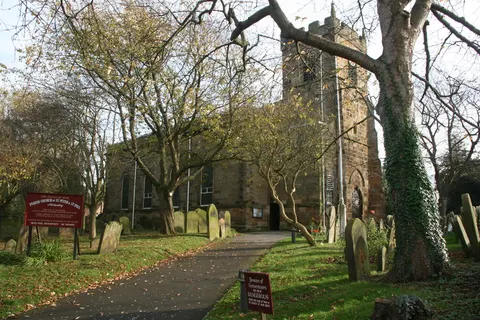

The parish church stands at the eastern end of the town, beside the Manor House, with the river behind it. It does not look medieval, and mostly it is not. Its nave is a plain, broad, classical box of 1771, aisleless and flat-ceilinged. But walk round to the tower and the chancel and the stonework changes. These, the Victoria County History judged, are fifteenth-century, the oldest fabric on the site. And the site is older still: there was a church here, and a priest, when the Domesday commissioners came in 1086.
The church of the barons
Like the town, the church belonged to its lords. Guy de Balliol gave it, in the reign of Henry I, to St Mary’s Abbey in York, along with a carucate of land. In 1360 a man who took his name from the town, William Stokesley, founded a chantry in it, dedicated to the Blessed Virgin. It was known as Middleton’s chantry, and it was a failure from the start. Its endowment was so small that by 1375 it had stood empty, the County History says, “no small time” for want of money. A plan to move its funds to Guisborough Priory got a royal licence and then quietly came to nothing; the chantry was still there in the sixteenth century.
In 1448 the Abbot of St Mary’s was licensed to hand the living over to the Dean and Chapter of York Minster, and after the Reformation it went to the Archbishop of York, whose successors still hold it. The registers of baptisms, marriages and burials begin in 1571.
The cups bear the words “Deo & Ecclesiae de Stokesley”: to God, and to the church of Stokesley.
The church’s silver is a small window onto the seventeenth century. Two covered cups and a paten were made in 1678, probably by the London silversmith Francis Garthorne. One cup was the gift of Sir James Pennyman, baronet, the other of the rector, Thomas Pennyman. The churchwardens, William Potter and Thomas Hunt, had their names put on the paten.
The later fittings are Victorian: new benches and a new font in 1875, and a clock given in 1887 for Queen Victoria’s Jubilee. On the south-west corner of the nave there is a sundial of 1822 with the motto Hora pars vitae, the hour is a part of life, which is a good thing for a churchyard to remind you of. The County History, in 1923, calls the church St Peter’s. Today it is the church of St Peter and St Paul.
The mass house
The lords of the manor for much of the seventeenth and eighteenth centuries were Catholics, and they kept a chapel, the “mass house”, probably beside the manor house, where the Catholics of the district could worship. In 1746 the boys of Stokesley attacked it in force, plundered it, and burnt what they had taken around the market cross. (A local chronology dates the riots to 1745.) Catholic worship in the town would not be public again for more than a century: the Group’s diary records a mission opening in an upper room in the yard of the Angel Inn in 1860, and in 1873 the chapel of St Joseph was built just north of the town on the road to Stockton.
Mr Wesley comes to town
John Wesley preached in Stokesley twelve times between April 1752 and June 1790, when he was eighty-seven. His journal entries about the town are brief, the Methodist church’s history says, except for the first, in which he takes some satisfaction in having outwitted a mob that meant to break up his meeting. He helped to establish the first Methodist meeting house, built in about 1765 on Beck Side, and in July 1766 he preached in “the new house at Stokesley”, noting that it could not hold the congregation.
The Methodists kept growing. By 1812 there were seventy-seven members, and they bought a site on Back Lane, now North Road, for £160. The new chapel and minister’s house, finished about a year later, cost £1,322, nearly all of it borrowed. The debt hung over the society for decades, and in 1841 the bankruptcy of one of its leading members, the linen manufacturer Thomas Mease, who had just given the chapel an organ, was a heavy blow to the whole town: his mill closed and families moved away.
A chapel bought in secret
The man who rescued them was William Mewburn, born in Stokesley, who had started work in a solicitor’s office in the town and gone on to make a fortune as a stockbroker in Halifax. He cleared the old chapel’s debts by 1860, and let it be known that he would not be satisfied until Stokesley had a really good chapel. The problem was a site. In 1883 the Black Swan, the leading coaching inn in the town, came up for sale, and Mewburn bought it without letting anyone know who he was or what he wanted it for.
The memorial stones were laid on the 27th of May 1886, with the schoolchildren given a half-holiday to watch. The new chapel opened on the 6th of January 1887, thirteen months after work began. It cost £5,110, of which Mewburn gave £3,040. By February 1888 every penny of the rest had been raised, including, according to the subscription list, £3 3s from “Dear Herbert in Heaven”. The old chapel was sold for £370 and became a brewery, which is why Chapel Yard is now Brewery Yard.
And the others
The Primitive Methodists built their first chapel on Back Lane in 1835, for £264, with seats for two hundred, and moved in 1903 to a new building on College Square, which later became the NFU building; the two Methodist congregations joined in 1941. The Congregationalists built a chapel too, in 1819 according to the County History or 1809 according to the local chronology; it is one of the dates the Group may be able to settle.
Walk the length of the High Street today and you pass the sites of most of them. The mob, the mass house and the coaching inn have all gone. The arguments they represent, about who could worship where and how, have mostly gone with them, and it is easy to forget how fiercely this small town once had them.
Sources
Every fact in this feature comes from the sources below. The prose is ours; short quotations are marked.
- 'Parishes: Stokesley', VCH North Riding vol. 2. Victoria County History, via British History Online, 1923.
- The Methodist Chapels of Stokesley (researched by Tom Berry, 1986). Stokesley Methodist Church.
- Stokesley | Domesday Book. Open Domesday (Anna Powell-Smith).
- Fifty Interesting Places: Stokesley. Cleveland & Teesside Local History Society.
- Stokesley Timeline. Stokesley Local History Group (Google Site).
Last reviewed 10 October 2026. Spotted a mistake or know more? Tell us.